
Chesapeake VINE Release Coverage
Virginia Jail VINE is a free, secure, and confidential service for a specific-person custody search and event registration. It receives information from participating local jails. For Chesapeake, it may carry a custody event transmitted for a person at Chesapeake Correctional Center. It is not an official list of everyone released today and should not be searched as a broad feed.
The system boundary is crucial. Local-jail VINE does not automatically follow a person into a Virginia Department of Corrections prison. VADOC uses NAAVI for its state custody notifications. A federal detainee or prisoner is outside both services and must be checked through the Federal Bureau of Prisons or the relevant federal authority. A local “release” can also mean transfer rather than return to the community.
VINE and the Chesapeake Tyler portal serve different roles. Tyler shows an indexed local booking and an “In Custody” field, plus booking dates. VINE provides a specific-person custody search and registration when the local agency transmits its data. Neither is a durable past-and-present release archive. The Sheriff’s formal record remains the source for the exact release time, release type, authorizing document, detainer, and receiving agency.
| Custody system | Notification route | Main limit |
|---|---|---|
| Chesapeake local jail | Virginia Jail VINE | Only participating transmitted events |
| VADOC state custody | NAAVI | Separate registration from local VINE |
| Federal custody | BOP locator and federal records | Not covered by VINE or NAAVI |
The Virginia VINE state page appears in the matched manifest capture below.

The landing page begins the specific-person check, while the matching record controls which alerts can be offered.
Search Chesapeake VINE Inmate Records
Use VINE for one identified person. Name variations and shared names can produce uncertainty, so compare the record’s identifier, custody location, and other displayed descriptors. A booking photo, if the interface supplies one, should not be the sole match point. Record the exact wording rather than converting a status into a broader claim.
- Open the Virginia state VINE page and choose the current custody or offender search.
- Enter the person’s name or an offender or booking identifier supported by the interface.
- Try a careful spelling or alias variation if the first search fails. Do not treat no result as release proof.
- Resolve close matches with an identifier, custody location, and other displayed facts.
- Open the matching record and note status, location, event wording, and the last-updated time.
- When a result says released or out of custody, confirm disputed details with the Sheriff’s status line or release record.
The Chesapeake Sheriff’s Tyler inmate inquiry is a useful local cross-check. It is a current-custody portal, not a past-release archive. Saving its Subject Number or Booking Number can make a later Sheriff record request more precise. The complete named-person workflow appears on the Chesapeake released-inmate search.
If the Tyler entry disappears, preserve uncertainty. The change could reflect community release, transfer to VADOC, transfer to another jail, a federal or immigration handoff, a spelling or query issue, or a data correction. A VINE event can narrow that question only to the words transmitted. Asking Sheriff Records for the custody destination is the direct way to distinguish departure from Chesapeake custody from release to the community.
Note: No VINE match may reflect spelling, lag, transfer, nonparticipation, or record lifecycle, not a confirmed release.
Read Chesapeake VINE Release Results
A result is only as broad as the field displayed. A current location can show where a participating agency reports the person, while a custody-change event shows that an event was transmitted. Neither necessarily states the legal disposition, physical exit time, or receiving agency. Read each field and its timestamp together.
| Displayed item | What it can establish |
|---|---|
| Name or identifier | Which record is being viewed, after identity is resolved |
| Custody status | The status transmitted by the participating agency |
| Facility or location | The reported holding location or agency context |
| Release or custody event | The exact event wording supplied to VINE |
| Last update | How current the displayed transmission may be |
| Notification options | Channels and events offered for that record |
If the record reports “released” or “out of custody,” treat that as the participating agency’s transmitted event. For the exact release time, authorizing order, disposition, detainer, or destination, call Chesapeake Correctional Center at 757-382-2883 or request the Sheriff’s existing release and transfer record.
A last-updated value deserves as much attention as the status. The Sheriff warns that local status changes quickly, and VINE relies on transmitted events. Write down both the event and its update time when confirmation matters. Later agency records may clarify an apparent conflict without proving that the earlier VINE display was wrong at the moment it was captured.
The release record has the higher evidentiary rank for a local custody transition. Request the existing entry that states release date and time, disposition or destination, release authority, detainer, and receiving agency. VINE is most useful as prompt notice that tells the recipient when to make that focused confirmation. It should not be expanded into facts the event screen does not display.
Set Chesapeake VINE Release Alerts
Registration starts from the correct person record. The interface is a changing JavaScript application, so button labels and offered channels can change. Use the control equivalent to Register or Get Notified and select only events offered for that record. Release, transfer, and other custody changes may be distinct events.
- Open the confirmed person record and choose the current notification-registration control.
- Select release or another custody event when that event is offered.
- Choose telephone, text, or email from the available channels.
- Enter the contact details. For a telephone alert, create the requested PIN to acknowledge the automated call and stop repeat calls.
- Complete any text or email confirmation shown by the current interface.
- Keep the confirmation and the instructions for updating or cancelling registration.
Do not assume every event supports every channel, and do not promise a specific PIN length unless the live screen states it. Registration details are confidential. An alert is supplemental, so urgent safety or exact-time questions still go directly to the holding agency.
A telephone PIN serves a limited purpose: it lets the recipient acknowledge an automated call and stop repeat calls. It is not the person’s booking identifier and should not be entered into a jail search. Text and email confirmation steps may differ from the call process. Keep the registration confirmation so the alert can be changed or cancelled through the instructions supplied by the service.
Chesapeake VINE Does Not Transfer
Virginia deliberately separates local and state notifications. When someone leaves Chesapeake Correctional Center for Indian Creek, St. Brides, or another VADOC institution, the local VINE event may describe departure from city custody. That departure is not necessarily community release. VADOC’s Victim Notifications page expressly says its NAAVI service is not connected to VINE registrations at local jails.
Eligible users must register separately with NAAVI for state custody events. VADOC describes notices for state transfer, advanced release, and actual release. Advanced notice is typically sent about 30 days before the anticipated date and may be updated if that date changes. The actual-release event means the person is no longer in VADOC custody, after which state notifications stop.
The official VADOC notification boundary is visible in this matching capture.
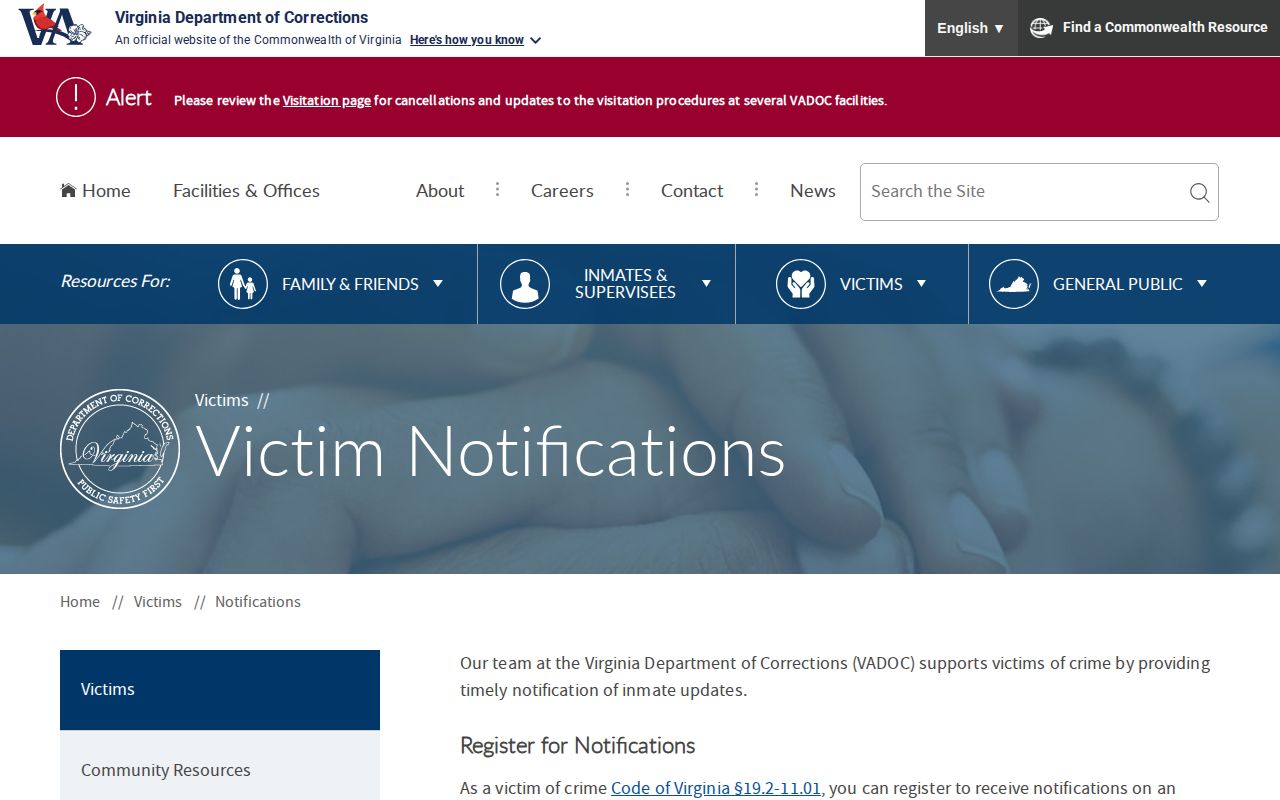
The distinction means a local registration must not be assumed to survive a transfer into state custody.
The separate NAAVI state-custody service is shown in a second subject-matched capture.

NAAVI follows qualifying VADOC events; it is not a replacement for the Chesapeake local-jail VINE record.
Confirm Chesapeake VINE Release Alerts
VINE depends on events sent by the participating agency. Alert timing and absence are not conclusive. A release alert can be corroboration, but the Chesapeake Sheriff’s release and transfer record is stronger proof because it can show date, disposition, authority, detainer, and receiving agency. If the person entered VADOC, the later VADOC status and signed release papers outrank a projected date.
Federal custody is not included. Use the official BOP locator when the Sheriff record points to federal transfer. Immigration custody likewise has its own federal locator. A VINE result should never be stretched beyond the agency and event it actually names.
The BOP locator can show a federal release date and “Not in BOP Custody,” but that does not prove the person is free of another custody system or federal supervision. An ICE transfer requires the ICE locator and the Sheriff’s local transfer record read together. These federal checks are fallbacks triggered by an actual federal lead, not substitutes for a Chesapeake VINE search.
No Chesapeake VINE Inmate Match
Start with spelling and identifiers. Then check the Sheriff portal for a current local booking. If local custody ended, ask for the release or custody-transfer record. A state transfer calls for the VADOC locator and separate NAAVI registration. A federal or immigration handoff calls for the relevant federal system.
Court records serve a different role. They can establish disposition and sentence, but usually do not prove when jail staff completed release processing or whether another authority took custody. Compare the court order with the agency release record rather than treating one system as a full substitute for the other.
Virginia’s sex-offender registry is also separate. It covers only people with a statutory registration duty, not everyone released from Chesapeake. A registry entry may remain relevant after custody, but it does not establish where the person was jailed or when release occurred. Use it only when that specific legal channel applies, and do not republish details that are not needed to verify the record.
When sources appear to disagree, keep both timestamps and scopes. An empty local roster, a VINE event, and a new VADOC location can all be accurate if Chesapeake transferred the person to state custody. The Sheriff destination field and the receiving agency’s later entry reconcile that sequence.