
Chesapeake Parole and Probation
Parole and probation are forms of supervision, but they begin in different ways. Parole is release from incarceration under Virginia Parole Board authority for a person who is legally eligible. Probation is imposed by a court. It may begin after an active jail or prison term, or the judge may suspend confinement and order probation instead. Neither term proves the exact hour a person left Chesapeake Correctional Center. The jail release record remains the stronger source for that physical transition.
The supervising body matters. State felony probation and parole in Chesapeake generally run through the Virginia Department of Corrections, commonly called VADOC. A court-directed local program may instead run through Chesapeake Community Corrections. The release order, sentencing order, or supervision paperwork should name the authority.
| Point | Parole | Probation |
|---|---|---|
| How it starts | Board-authorized release from a parole-eligible term | Court order, with or without prior confinement |
| Likely Chesapeake authority | VADOC District 31 | VADOC District 31 or local Community Corrections, depending on the order |
| Useful public proof | VADOC status, Board decision, release papers | Court order, docket status, VADOC status when state-supervised |
| End of supervision | Board or VADOC discharge record | Court or supervising-agency termination or discharge record |
- Parole
- Conditional release from incarceration under parole authority.
- Probation
- Court-ordered supervision in the community.
- Discharge
- The formal end of custody or supervision.
- Absconder
- A person alleged to have stopped complying with supervision or reporting.
Verify Chesapeake Supervision Status
The VADOC Inmate and Supervisee Locator is the first public check for state supervision. It covers people in VADOC custody and people supervised through district offices. Search by name or seven-digit DOC ID, then compare the displayed location and correctional status. A common name needs more than one matching detail. The locator is updated daily, but VADOC warns that information can be inaccurate or out of date.
- Read the release paper or sentencing order and identify VADOC, the Parole Board, a court, or Chesapeake Community Corrections.
- Search the VADOC locator when state custody, parole, or felony probation is indicated. Record the exact status and date shown.
- Use the Virginia court case gateway to find the Chesapeake disposition, probation term, and later discharge entries.
- Call the named office with the full name, DOC number if known, and court case number. Ask only what public status can be confirmed.
- When online sources conflict, request the existing status, release, or discharge document from its custodian.
A fully discharged person may no longer fall within the locator’s described population. No result therefore does not prove there was no supervision. A narrow record request and the court docket can outlast the public locator entry. The broader Chesapeake release-record path is available from the released-inmate search home page.
The official VADOC locator is shown in the captured interface below.
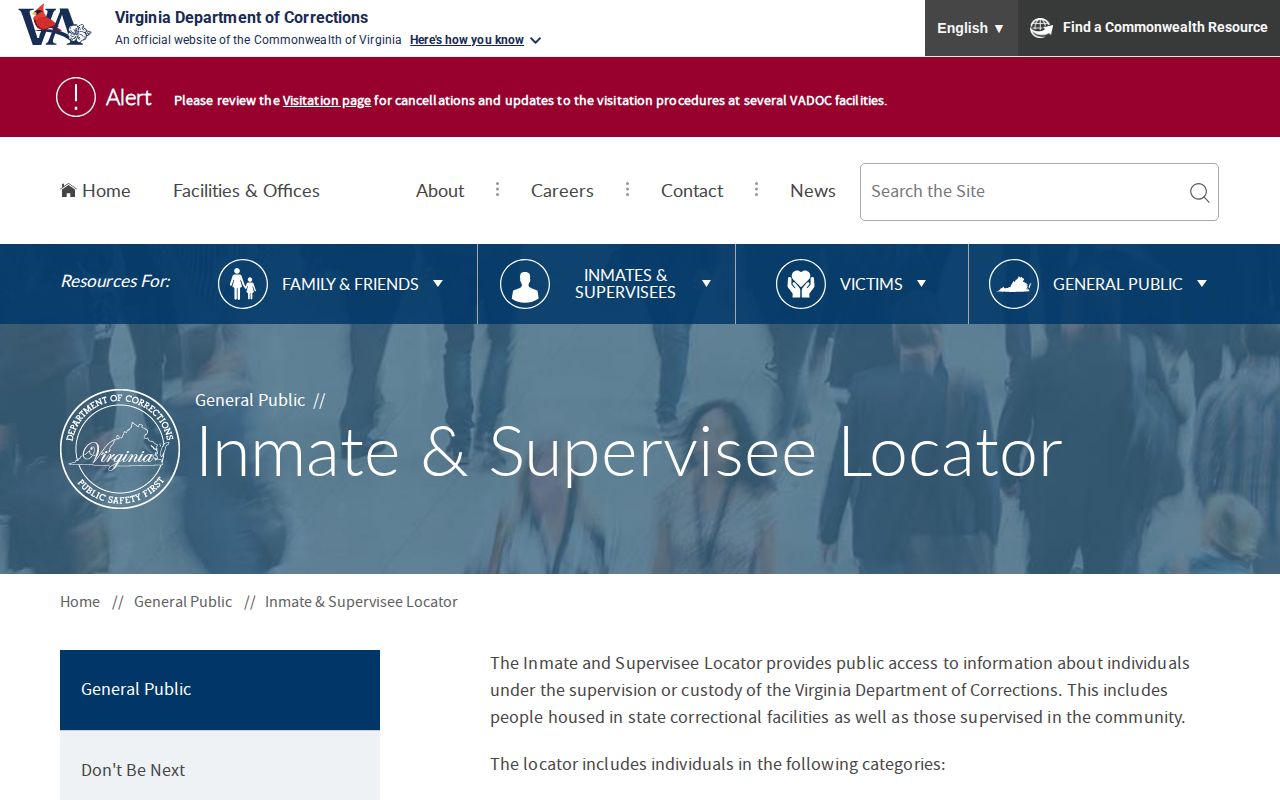
The locator can connect a person to state custody or supervision, but it does not replace a signed discharge paper or local jail release record.
Virginia court records can fill a different gap. General District records may show a misdemeanor order or the preliminary stage of a felony. Circuit records may show the felony trial, appeal, final sentence, and later probation entry. Match the case number and disposition date before relying on either trail. A court entry can prove that probation was ordered, yet it usually cannot prove when intake staff completed a jail release or whether another detainer caused a handoff.
Note: A correctional status proves the status shown at that update, not the exact time Chesapeake jail custody ended.
Chesapeake District 31 Records
VADOC’s facilities and offices directory identifies Probation and Parole District 31 as the state supervision office serving the City of Chesapeake. The office is the relevant contact when the VADOC result or release order points to state probation or parole. Do not infer District 31 supervision merely from a Chesapeake home address. The actual order and correctional status control.
VADOC Probation and Parole District 31808 Live Oak Drive, Suite 125
Chesapeake, VA 23320
757-424-6760
Use a full name, DOC number when available, and a court identifier. Ask whether District 31 is the proper office and what public status may be confirmed. Adult supervision files may be withheld under Virginia Code §2.2-3706(B)(6), so a request for a narrow status or discharge document is more sound than a demand for the whole file.
The VADOC office directory capture below is the manifest image matched to Chesapeake District 31.

That directory separates the Chesapeake supervision office from the two VADOC prisons also located in the city.
Which Chesapeake Supervision Office?
Chesapeake has three distinct post-custody structures. This local split is the defining Chesapeake supervision issue. District 31 handles state probation and parole. Chesapeake Community Corrections supports local pretrial and community-based probation programs used by courts as alternatives to local confinement. Court and recovery initiatives described in the statewide transition and reentry work add services, but do not change which agency has legal supervision authority.
Community Corrections is listed at 100 Outlaw Street, Chesapeake, with telephone 757-543-2844. A pretrial release or local community-based probation order should be checked with that program and the ordering court. It should not be treated as VADOC parole. Likewise, a VADOC supervisee result does not show the exact release mechanics at the city jail.
Chesapeake Parole Board Records
The Virginia Parole Board plays a different role from District 31. It decides parole for eligible cases. Its Public Hearings page posts agendas at least three working days before a qualifying public meeting, includes a viewing route, and archives minutes. The schedule is irregular and event-driven. It is not a full calendar of every internal review.
The Parole Reports page publishes monthly decision PDFs and annual reports. Monthly reports are retrospective. The Board says decisions are posted at the end of the following month after required notice. They may identify the person, offense, jurisdiction, sentence, time served, grant or denial, reasons, final vote, and members. A missing current agenda is not proof of ineligibility or denial.
The official hearing channel appears in this matched capture.

Use the agenda to understand a public meeting, then use Board and VADOC records to establish the decision and later custody status.
Chesapeake Grant Versus Release
A Board grant is not physical release. Under the current statutory framework, VADOC sets the release date no sooner than 30 business days after grant notice, subject to exceptions. Preparation, a detainer, another sentence, or another legal event can keep custody in place. A Board report establishes the decision; VADOC status and signed release papers establish the later release.
Virginia generally abolished discretionary parole for felony offenses committed after 1994, but §53.1-165.1 contains exceptions. For parole-eligible cases, §53.1-151 governs calculation and includes exclusions and special rules. The Board provides formal routes to appeal parole ineligibility and seek reconsideration of a not-grant decision. Eligibility should not be guessed from a public agenda.
The monthly decision-report channel is shown below.
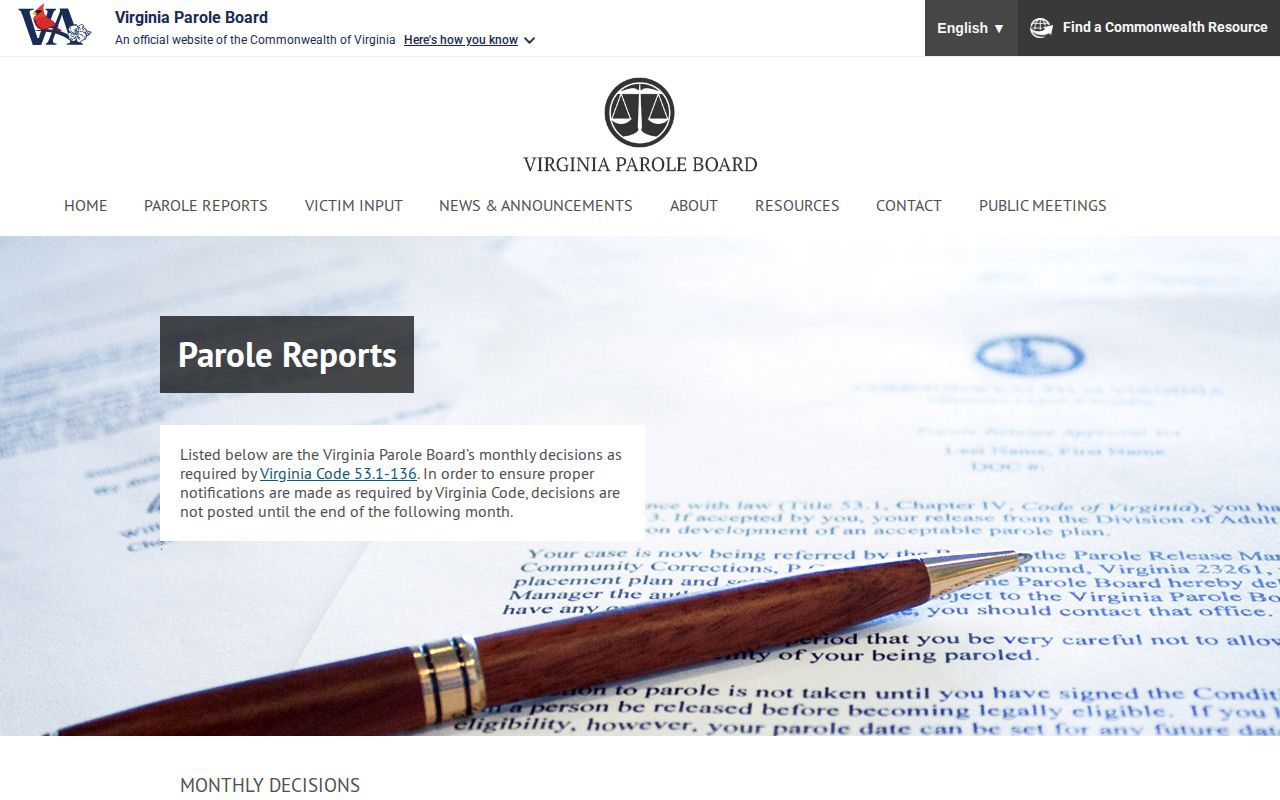
Its delayed reports document grant or denial decisions, not a live list of people leaving prison.
Note: Signed release papers and post-event VADOC status are stronger proof of departure than a Board grant or future date.
Chesapeake Violations and Absconders
Supervision conditions come from the court order, parole terms, and agency documents. A violation is an alleged failure to follow those conditions. It may lead to agency action, a court hearing, a capias, or a warrant, but it does not itself establish a new conviction. The underlying order and official case record supply the needed context.
No durable official statewide or Chesapeake name-by-name absconder list was verified. Check District 31 and the public court docket when that status matters. An absent web result does not prove supervision ended or that no warrant exists. Do not approach an office unannounced to investigate another person. Time-sensitive warrant questions belong with the court or law enforcement.
Virginia Jail VINE is also not an absconder or probation-status database. Its Chesapeake role is notice of participating local-jail custody events. VADOC uses separate NAAVI notifications for qualifying state-custody events. Neither service should be used to infer that a supervision violation occurred. A returned-to-custody event, when shown, still needs the court or agency record for its legal cause.
Confirm Chesapeake Supervision Discharge
Supervision ends under the court order, Board authority, statutory term, and VADOC record. A later court entry may show termination. VADOC may display a changed correctional status, while a person-held discharge document can give direct proof. These records are stronger than an assumption based on a missing locator result.
Ask the office that held the record for an existing discharge or status document. Keep the request narrow and identify the person and case. If the question is when physical custody ended rather than when supervision ended, obtain the Chesapeake Sheriff release or transfer record instead. The events can occur years apart.
VADOC accepts focused records requests through the office holding the record, subject to statutory exemptions for adult probation and parole files. Public correctional status, custody or parole status, facility location, and certain date categories are narrower than officer notes or a complete case file. A person-held discharge paper is often the clearest evidence because it identifies the affected person and the completed milestone without requiring an inference from a vanished web result.