
Chesapeake Projected Versus Actual Release
A projected date is a present calculation, not the release event itself. VADOC policy permits public release of projected parole eligibility, mandatory parole, and good-time release dates at the time of inquiry. The public locator also supplies location and release-date information where displayed. This research did not verify one universal screen label for every record. Record the exact current label on the result rather than calling every date “tentative” or “projected.”
An actual release is the completed custody transition. For a state prisoner, signed papers may include an Order of Release, Conditions of Probation, Conditions of Parole, and a notification-of-release letter. A post-event VADOC status can corroborate them. At Chesapeake Correctional Center, the Sheriff release or transfer record is stronger than roster disappearance because it can state the exit, authority, detainer, and receiving agency.
A transfer date is not interchangeable with a discharge date. The person may leave Chesapeake’s roster for Indian Creek, St. Brides, another VADOC institution, or another authority while the same sentence remains active.
A pretrial detainee has no sentence-based release date. Bond may be processed after paperwork and Magistrate or court authorization, while dismissal, a court order, a detainer, or another case may change custody. Bond release is not earned-time computation.
A court disposition and a custody event also answer separate questions. The sentencing order establishes the active and suspended terms imposed by the judge. It may state probation and other legal conditions. The agency calculation applies credits and sentence events, while the release record documents what occurred at the custodial boundary. All three may be needed when a projected date appears inconsistent with the final exit.
Find Chesapeake Release Date Records
Start by identifying who owns the sentence. The Chesapeake Sheriff calculates local jail sentences and prepares jail-credit material for people sentenced to state time. VADOC computes qualifying longer state-responsible sentences. A changed location from Chesapeake Correctional Center to a VADOC prison may be a transfer, not community release.
- Read the sentencing order and identify active time, suspended time, offense date, and whether the term is local or state responsible.
- For a local sentence, contact Chesapeake Sheriff Support Services and Records and ask for the existing calculation or release record.
- For state custody, search the VADOC Inmate and Supervisee Locator by name or seven-digit DOC ID.
- Open the correct record after comparing identifiers. Capture the date label, date, status, location, and update context exactly as shown.
- Compare the result with the court order and jail-credit history. Ask the responsible records office about a specific discrepancy.
- After the date passes, confirm actual departure through status, release papers, or the agency’s release or transfer record.
The locator covers current VADOC custody and supervision, not a permanent archive of every person fully discharged. It is updated daily but may be inaccurate or outdated. No result does not prove release. For the wider agency-by-agency search, use the Chesapeake released-inmate lookup.
The official VADOC locator is shown in this subject-matched capture.
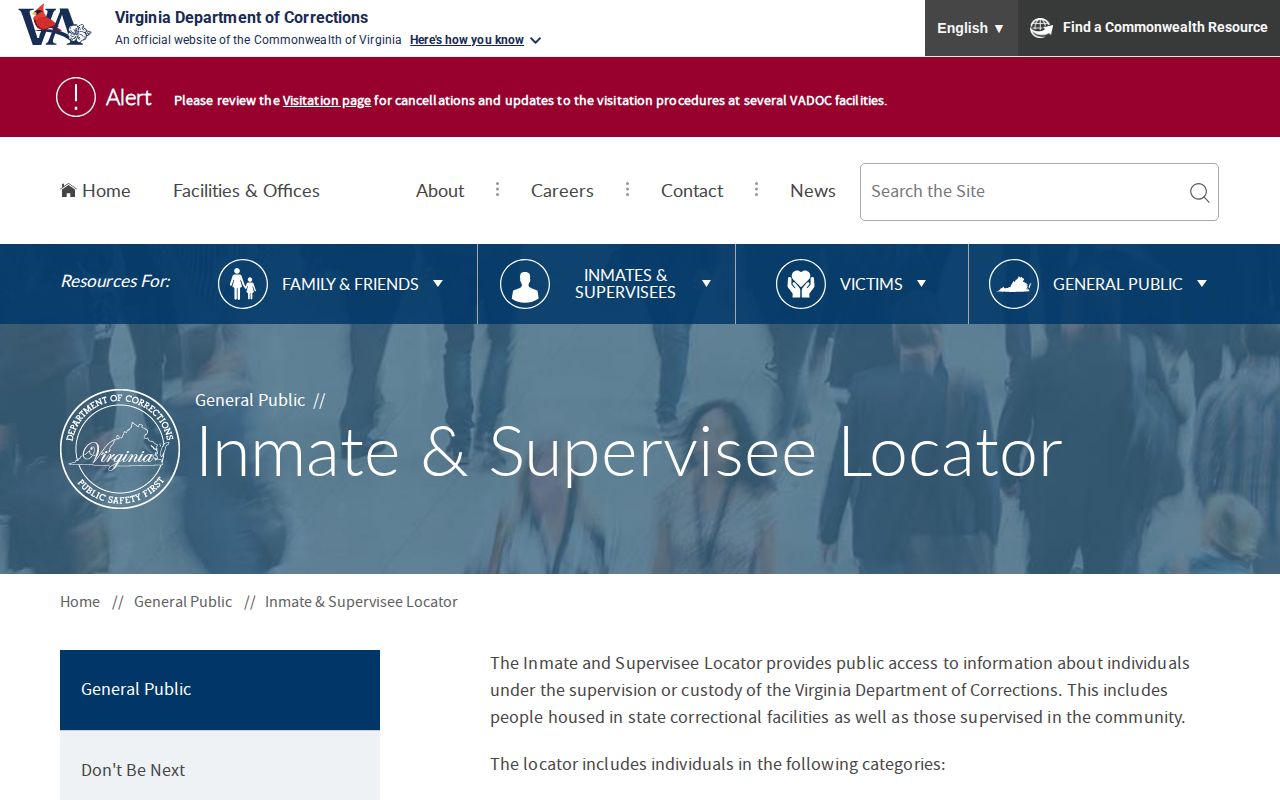
The interface must be read as it appears on the matching person’s current record; no release-date label should be invented.
Note: A missing VADOC record can reflect full discharge, identity mismatch, restricted location, or scope, not proof of an exact release date.
Who Calculates Chesapeake Release Dates?
Chesapeake Records calculates local jail sentences. It also supplies jail-credit documentation for state sentences. VADOC then applies the governing state calculation to a state-responsible term. This administrative seam explains why a person may leave the city roster while still serving time under Virginia authority.
| Situation | Primary calculation source | Best confirmation |
|---|---|---|
| Pretrial or bond | No sentence-credit projection | Court or Magistrate order and Sheriff custody status |
| Local jail sentence | Chesapeake Sheriff Records | Local calculation and release record |
| State-responsible sentence | VADOC, using jail-credit material | Locator date as labeled, time-computation record, release papers |
| Parole-eligible sentence | VADOC calculation and Board authority | Board decision plus later VADOC release date and status |
The official VADOC Time Computation page appears below.
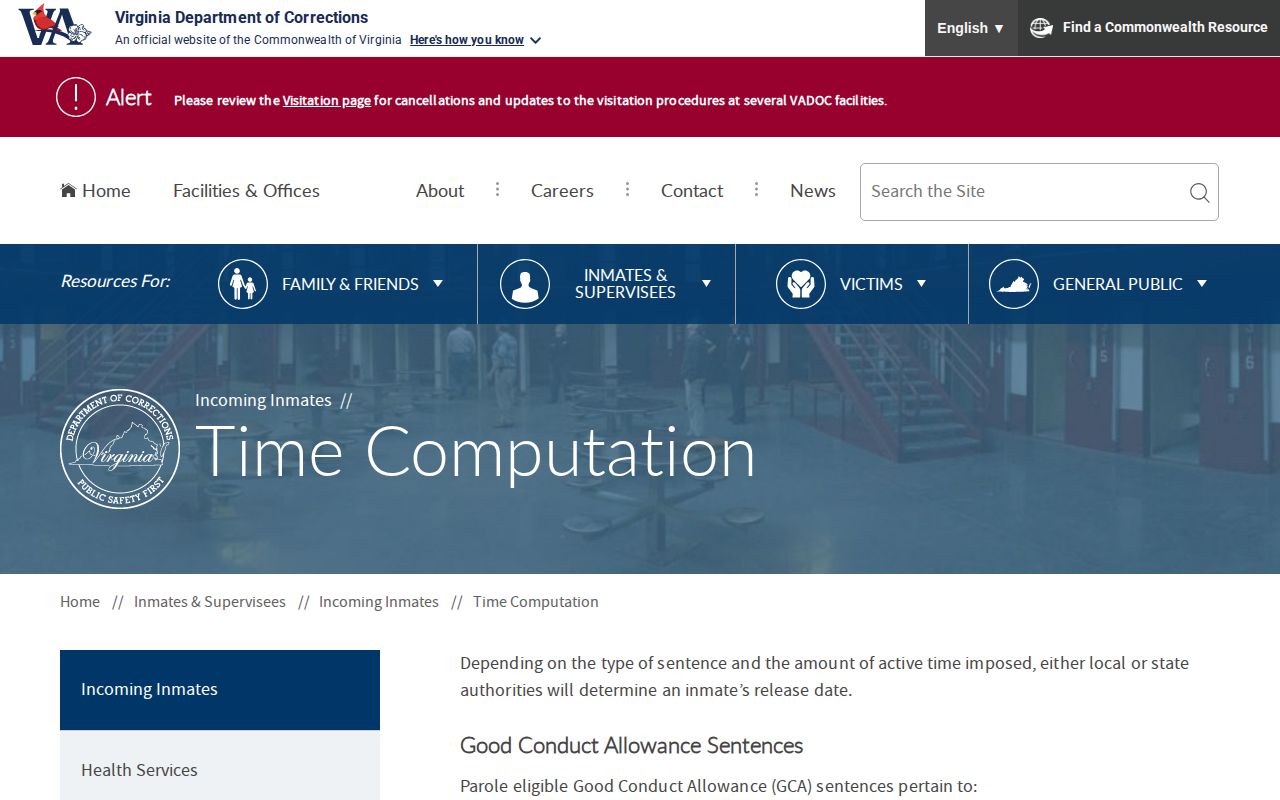
It ties the estimate to jail credit, sentence type, active term, earning class, discipline, and other sentence events.
For an apparent mismatch, identify the exact field rather than asking for a new calculation from scratch. Compare the offense date, each sentencing order, whether terms run together or one after another, the credited pre-sentence jail days, and the current earning class. Chesapeake Records can address the local jail record it created. VADOC’s time-computation unit is the proper state contact for the state calculation.
Chesapeake GCA Release Calculations
Good Conduct Allowance, or GCA, is the older Virginia framework. VADOC describes it for parole-eligible felony offenses committed before January 1, 1995 and misdemeanor offenses committed before July 1, 2008. The offense date matters. The age of a conviction alone does not place a case in GCA.
For an active sentence, or combined parole-eligible GCA terms, totaling more than 12 months, VADOC calculates discretionary parole eligibility, mandatory parole, and good-time release dates. GCA can range from zero to 30 days per 30 days served according to class. Its statutory framework includes §§53.1-199 through 53.1-201. Those older parole and good-time milestones must not be blended with modern earned sentence credits.
For a parole-eligible term, §53.1-151 contains first-eligibility rules plus serious exclusions and special rules. The simplified fractions in the statute are not a safe way to predict an individual date without the full sentencing record.
Parole eligibility is only a point at which a legally eligible case may be considered. It is not a promised release date. Mandatory parole and good-time dates are also distinct categories. A Board decision report can establish grant or denial, but VADOC still sets and administers the later release event under the governing law and any applicable hold.
Chesapeake ESC Release Calculations
Earned Sentence Credits, or ESC, govern the modern category. Under the version of §53.1-202.2 effective on the research date, a person convicted of a felony committed on or after January 1, 1995 and sentenced to state or local confinement may earn credits after the final conviction order. One credit equals one day deducted. A future statutory version effective in 2028 should not be applied to a 2026 calculation.
VADOC uses ESC-1 and ESC-2 categories. Offenses enumerated in §53.1-202.3(A) are capped at zero to 4.5 days for each 30 days served. Other qualifying offenses under subsection B use four levels. Level I permits 15 days per 30, Level II 7.5, Level III 3.5, and Level IV zero. Class depends on rule compliance, program participation or cooperation, and disciplinary history. Annual review is required.
The common “85 percent” shorthand fits only the maximum 4.5-per-30 capped rate, where roughly 85 percent remains to be served. It is not a rule for every post-1995 felony. A qualifying nonviolent case at the maximum 15-per-30 rate may serve no less than roughly 67 percent. Both figures are approximate, and neither predicts an individual date without the offense category, active term, credit class, jail credit, and later events.
Section 53.1-202.4 directs VADOC to set classification, earning, forfeiture, and related requirements. That is why a simple online percentage calculator cannot yield an official Chesapeake release date. Even the correct maximum rate does not reveal the person’s present class, lost or restored credit, all active terms, or a detainer that affects destination.
Why Chesapeake Release Dates Shift
Chesapeake’s local-to-state calculation seam makes the displayed date especially sensitive to the record path. Sheriff Records may calculate a local term or supply state jail-credit material. VADOC applies the relevant GCA or ESC scheme. A class change, disciplinary event, corrected jail credit, or later sentence event may then move the displayed date without making the earlier display fraudulent.
| Factor | Possible effect | Where to verify |
|---|---|---|
| Pre-VADOC jail credit | Changes credited time before state reception | Sheriff credit material and VADOC computation |
| ESC or GCA class | Changes the rate at which time is deducted | Applicable statute and VADOC record |
| Disciplinary event | May reduce, forfeit, or later restore credit | VADOC time-computation record |
| New or corrected court order | May change the active term or sentence structure | Signed court order and calculation update |
| Consecutive sentence | May extend the combined active term | Court orders and VADOC computation |
| Detainer or hold | May turn release into transfer to another authority | Release/transfer record and receiving-agency status |
| Parole decision | May create a later release-setting process | Board decision and VADOC status |
Virginia generally abolished discretionary parole for felony offenses committed after 1994, subject to exceptions in §53.1-165.1. A Parole Board grant still does not mean same-day release. VADOC sets the later date under the governing framework, and another hold may lead to transfer.
Note: A moved projected date may reflect a valid change in credit, class, sentence, or custody destination rather than a data error.
Confirm Chesapeake Actual Release Dates
After the projected day, look for the completed event. VADOC says a person who satisfies a state sentence is discharged or leaves on parole. Its facility-release materials state that release occurs by 11:59 p.m. on the release date, weather permitting. Applicable papers are read, signed, dated, and witnessed. A detainer can still result in handoff rather than community release.
The official VADOC Facility Release page is shown in the matched image below.
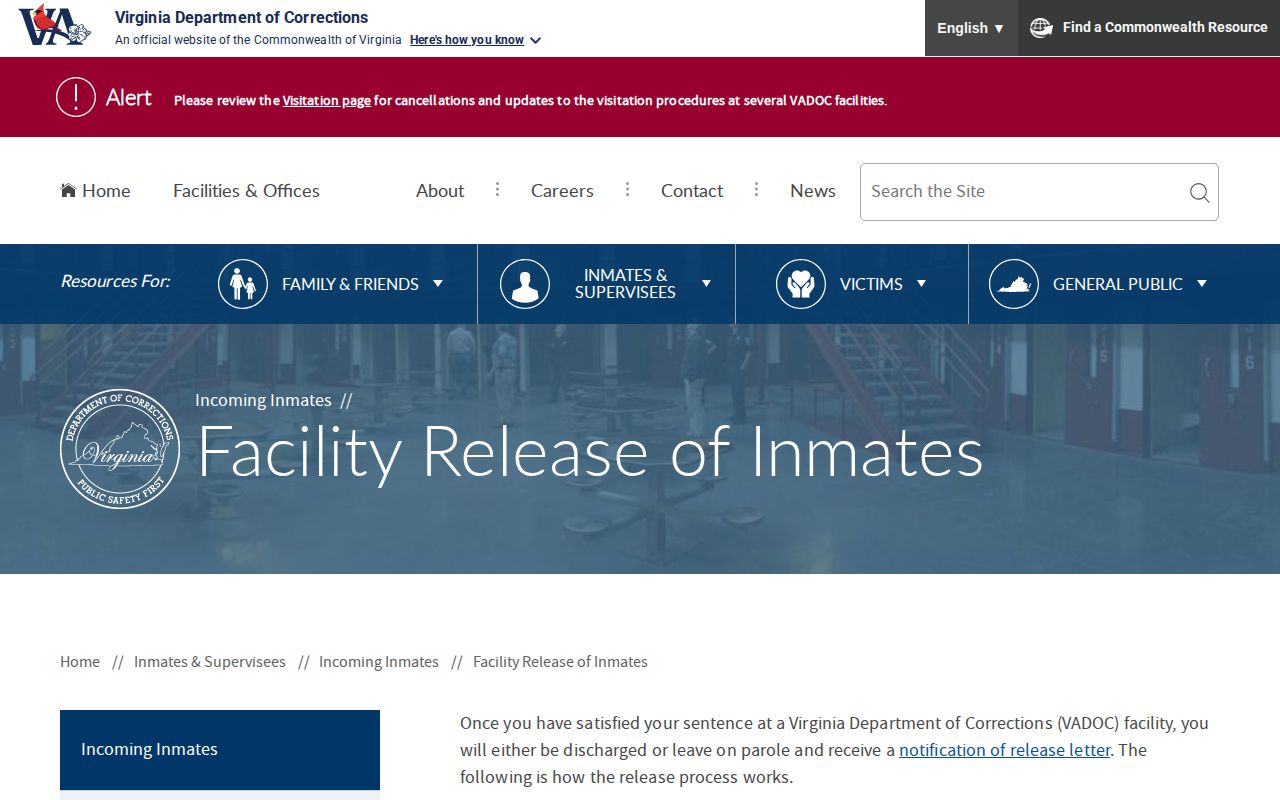
Those release procedures explain why the signed document and post-event status are stronger evidence than the earlier projection.
For a local sentence, request the Chesapeake Sheriff release or custody-transfer record. For state custody, compare the locator status, signed papers, and any eligible NAAVI notice. The separate VINE inmate check covers local-jail notifications; NAAVI registration is required for VADOC events. If the calculation appears wrong, VADOC directs time-computation correspondence to the Correspondence Unit/Court & Legal Section, P.O. Box 26963, 6900 Atmore Drive, Richmond, VA 23261. The main number is 804-674-3000.
An inactive person seeking their own archived VADOC material may use Form 050_F17. The form asks for identifying details, a prior DOC number, a notarized signature, and delivery to Central Criminal Records. It is a subject-access form, not a general third-party release-date request. Other requesters should seek the narrow public status or date record from the proper custodian and expect statutory exemptions to limit internal material.