
Chesapeake Juvenile Release Path
Chesapeake Juvenile Services Center is a secure juvenile detention facility operated through City of Chesapeake Human Services and regulated through Virginia DJJ. Young people are held by court order. Release is therefore tied to the juvenile court process, authorized parent or guardian notice, and any DJJ probation, parole, placement, or aftercare plan. It is not handled as an adult booking-list event.
The proper question is not whether a child appears in an adult search. It is which authorized office or person has the court-directed information. A parent or guardian who received intake notice should use the case contact and court paperwork. The DJJ First District Court Service Unit handles the local juvenile probation and parole route. The court can address an order or hearing. Facility staff can route an authorized caller, but public access to a child’s status is restricted.
Juvenile confidentiality is a legal access boundary, not missing data to bypass through adult rosters, photos, or unofficial databases.
Confirm a Chesapeake Juvenile Release
No adult-style public inmate lookup exists for Chesapeake Juvenile Services Center. The Chesapeake Sheriff’s Tyler portal concerns the adult city jail and must not be used as a proxy. A careful confirmation starts with the papers and contacts already connected to the juvenile case.
- Review the court order, hearing notice, and intake or case-contact information held by the authorized parent or guardian.
- Contact the juvenile’s assigned attorney, probation or parole officer, or case worker when one is identified.
- Use the Chesapeake Juvenile and Domestic Relations court process for questions about the controlling order.
- Contact the DJJ First District Court Service Unit for authorized probation, parole, and aftercare questions.
- Call the center only through an authorized family or case channel and follow its identity-verification rules.
- Do not publish the child’s name, photograph, location, or case detail in an adult released-inmate workflow.
A “no result” in the adult system says nothing about juvenile custody. It neither proves release nor confirms that a child was ever held. The underlying court and DJJ records have their own access rules.
Chesapeake Juvenile Center Contacts
The facility and service unit serve different roles. The center holds young people by court order. The First District Court Service Unit is the local DJJ probation and parole office and is the more relevant route for supervised aftercare. Callers should be prepared for identity and authorization checks. Public office hours do not predict when a court-authorized release will occur.
Chesapeake Juvenile Services Center
420 Albemarle Drive
Chesapeake, VA 23322
757-382-6364
DJJ First District Court Service Unit
301 Albemarle Drive, first floor
Chesapeake, VA 23322
757-382-8150
Monday through Friday, 8 a.m. to 5 p.m.
Ask the office what information can be discussed with the caller, which court controls the matter, and which assigned professional can address the release or aftercare plan. Do not ask staff to disclose another family’s confidential case.
Juvenile Release Records Stay Private
Adult public-record paths do not transfer to juvenile cases. The Sheriff FOIA page for past and present correctional-center inmates is an adult local-jail route. Virginia’s adult routine-booking-photo rule also should not be treated as a right to a juvenile image. The research directs juvenile release questions to the court, guardian-notification process, and DJJ service unit.
- Release
- A court-authorized end or change in secure detention, sometimes followed by conditions or another placement.
- Aftercare
- Services, rules, or support arranged after a young person leaves secure custody.
- Juvenile probation
- Court-linked community supervision for a young person under the terms of the juvenile case.
- Juvenile parole
- DJJ supervision after release from qualifying state juvenile custody.
Confidentiality also changes how conflicting information is handled. A family member should not try to resolve a discrepancy by posting identifiers online or searching photo mirrors. Bring the court paper, case contact, and precise question to the authorized office.
Adult and Juvenile Chesapeake Records
Chesapeake’s adult and juvenile facilities are close to the same court complex, but their records are not interchangeable. The city jail at 400 Albemarle Drive uses the Sheriff current-custody portal and formal release-record process. The Juvenile Services Center at 420 Albemarle Drive uses confidential court and DJJ channels. Similar street names do not erase that distinction.
| Custody setting | Correct release route | Public name search |
|---|---|---|
| Chesapeake Correctional Center | Sheriff status and release or transfer record | Official adult portal for indexed custody |
| Chesapeake Juvenile Services Center | Court, guardian, assigned case contact, and DJJ | No adult-style public lookup |
| VADOC state prison | VADOC locator and state release documents | State custody or supervision search |
This division prevents a common error: treating absence from an adult roster as proof that a young person was released. It is not evidence either way.
After Chesapeake Juvenile Detention
A release from secure juvenile detention can lead home, to another approved placement, or into a supervised plan. The precise destination and conditions depend on the court and DJJ case. Public-facing sources do not supply a universal checklist for a named child. Authorized family members should rely on the actual order and case team.
Court papers may set the next hearing, placement, probation term, or other condition. A DJJ professional can explain the service-unit role and the permitted communications. Facility staff may address approved logistics. Each source proves a different part of the transition. The court order controls the legal direction, while the facility records the custody handoff and the service unit manages assigned supervision or aftercare.
Practical questions should stay within that team. An authorized adult can ask who may pick up the young person, which document must be brought, whether a new placement receives custody, and when the next court or service appointment occurs. Staff may decline to discuss those facts with someone who cannot establish a lawful role. That refusal should not be treated as evidence about release.
If a case moves between local detention and a state juvenile placement, the receiving authority’s record becomes part of the chain. The initial center’s custody end does not by itself establish that the young person went home. The order and receiving placement resolve the transition.
Note: A move to another program is a custody or placement transition, not necessarily an unrestricted return to the community.
Official Chesapeake Juvenile Sources
The City of Chesapeake’s Juvenile Services page identifies the secure center and its public contact. The First District Court Service Unit page identifies the local DJJ office. These official pages provide the safe starting points without exposing a young person’s private record.
The Juvenile Services source is shown below as a visual reference.

The image confirms the public facility source, while any individual release question must remain within the authorized court, family, and DJJ process.
The DJJ page also has a matching captured source.
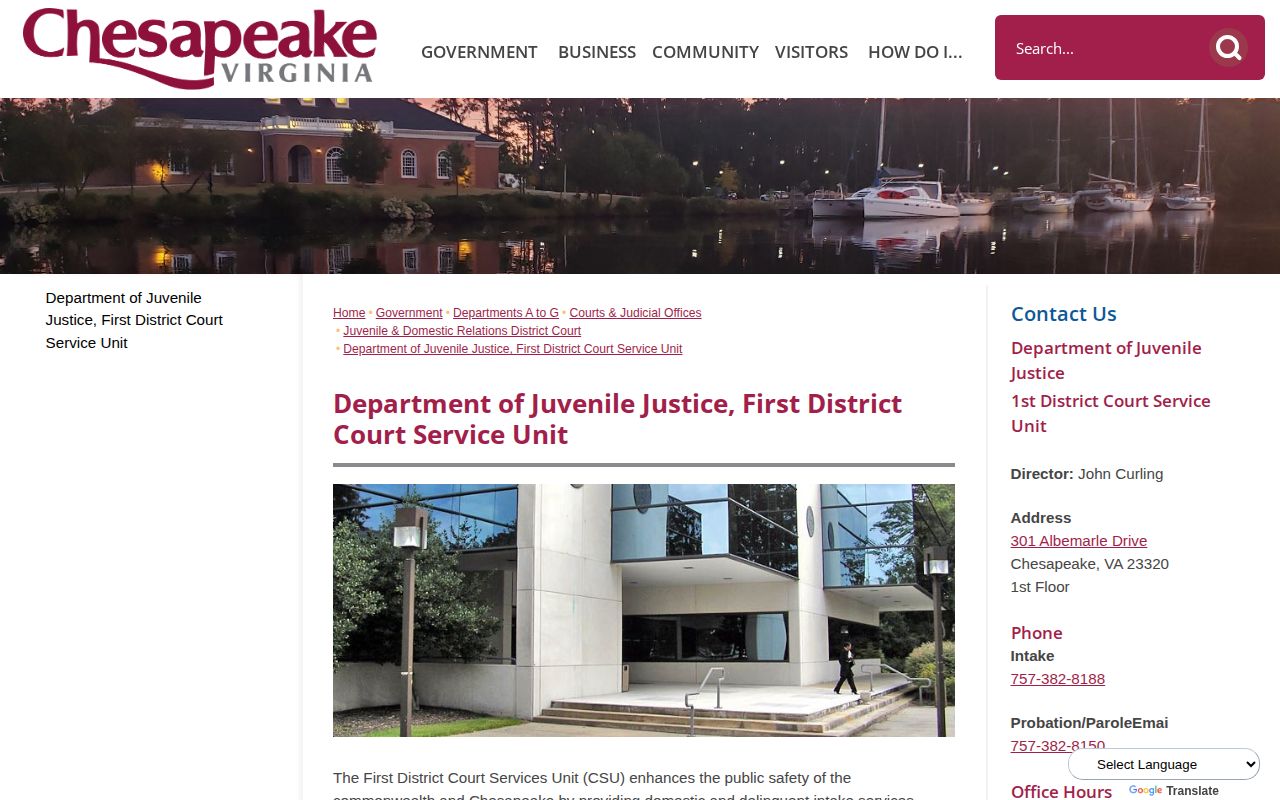
That office is the local link for authorized probation, parole, and aftercare questions after detention.
About Chesapeake Juvenile Detention
The City describes Chesapeake Juvenile Services Center as a secure, 100-bed facility for young people held by court order. That figure describes the facility, not a current population count. Intake includes parent notification, which reinforces why an authorized guardian and the assigned case team are the proper first contacts. It does not create a public booking list or a public release feed.
The center’s location near Chesapeake’s adult jail and court offices can cause a misleading search result. The adult Tyler portal may show an unrelated adult with a similar name. The VADOC locator covers the state adult custody and supervision system. Neither channel establishes a child’s custody, court disposition, or release. The First District Court Service Unit and the juvenile court hold the relevant authorized route.
A juvenile court order may direct release, continued detention, probation, parole, aftercare, or another placement. The exact transition should be read from that order and confirmed through the assigned professionals. A public website result cannot replace those records. If a parent or guardian believes the information is wrong, the safe response is to contact the case worker, attorney, service unit, or clerk rather than seek the child’s details through unofficial mirrors.
Privacy remains part of accuracy. Omitting a juvenile name, photograph, or case detail from an adult-facing system is not evidence that the government lost the record. It reflects a different legal process and a narrower group of people authorized to receive it.