
Understanding Chesapeake County Releases
A Chesapeake release record must show more than a name missing from a screen. Chesapeake Correctional Center is the city jail for recent local arrests, pretrial detention, and many locally served sentences. Its live inquiry is built for current indexed custody. Once a record changes or disappears, the Sheriff’s underlying file becomes the stronger source for the date, authority, and disposition. The outcome may be bond, recognizance, dismissal, time served, a court-directed release, or a handoff to another agency.
Custody can also belong to the Virginia Department of Corrections. Indian Creek Correctional Center and St. Brides Correctional Center are state prisons within Chesapeake, so their departures are VADOC events rather than city-jail releases. Juvenile release information follows a confidential court and Department of Juvenile Justice process. Federal and immigration holds add another boundary. In each case, “released” should name the agency whose custody ended and should not imply return to the community unless the record says so.
- Discharge
- The sentence or correctional term has ended under the responsible authority.
- Time served
- The court or jail credits enough time already spent in custody to complete the active jail term.
- Detainer
- A legal hold that can send a person to another authority when current custody ends.
- Parole
- Release from incarceration under supervision for a person who is legally eligible.
Chesapeake County Release Types
The next search depends on the release type. Sheriff Records can document a local disposition, while VADOC records control a state-prison discharge or parole event. A court result helps explain the legal basis, yet it may not show the exact time staff completed processing or whether a separate hold led to a transfer.
| Release type | What it means | Best next source |
|---|---|---|
| Bond or recognizance | Local custody ends after required authority and processing | Sheriff release record and court case |
| Sentence or time served | The active local term is complete after applicable credit | Sheriff Records and sentencing order |
| VADOC discharge or parole | State custody ends or changes to state supervision | VADOC status and signed release papers |
| Agency transfer | Chesapeake custody ends but confinement may continue | Receiving-agency entry and transfer record |
| Juvenile release | A confidential court-directed process applies | Parent or guardian, court, and DJJ unit |
Does a vanished roster entry prove release? No. It may reflect transfer, spelling, data lag, a correction, or an online record lifecycle change. Ask for the disposition and receiving agency.
Chesapeake County Release Record Fields
A useful release record links the person, the custody event, and the next destination. Not every public copy contains every field. Exempt material may be withheld or redacted, and a sealed or expunged record has separate access limits. A narrow request should seek the existing fields needed to distinguish release from transfer.
| Field | What it shows |
|---|---|
| Name and stable identifier | Connects the record to the correct person and avoids a same-name match |
| Booking or admission number | Ties the exit event to a specific intake |
| Release date and time | Marks when that agency’s custody ended |
| Release authority | Identifies the court, magistrate, sentence rule, or agency basis |
| Disposition or release type | Distinguishes bond, time served, discharge, or transfer |
| Detainer and destination | Shows whether another authority received the person |
| Supervising agency | Identifies probation or parole that follows physical release |
The Sheriff’s file may also contain charges, bond, court appearances, sentences, detainers, local sentence calculations, and state jail-credit work. Court orders supply the legal outcome. VADOC release papers can include an Order of Release, Conditions of Probation, Conditions of Parole, and a notification-of-release letter. Read these records together when one source does not answer the full question.
Request Chesapeake County Release Records
The Chesapeake Sheriff FOIA page expressly covers records of people held at the correctional center, past and present. Requests may be sent by mail, fax, email, made in person, or made by telephone. Writing is recommended because a precise request is easier to route. Ask for existing records, not an explanation the office would have to create.
- Give the full name and a Subject Number, Booking Number, date of birth, or narrow booking-date range.
- Request the booking and release or custody-transfer record, including date, time, disposition, authority, detainer, and receiving agency.
- Ask for electronic native-format copies and an advance estimate if cost is a concern.
- Review any redaction or withholding notice for its legal basis, and follow a referral if another known custodian holds the record.
Captain Timothy Morgan is the Sheriff FOIA contact at P.O. Box 15125, Chesapeake, VA 23328; 757-382-6159; fax 757-382-8972; SheriffFOIA@cityofchesapeake.net. Virginia’s response period is five working days. Written notice may add seven working days when timely production is impracticable. Charges are limited to actual cost, estimates are available, and a deposit may be required when an estimate exceeds $200.
The official request page shows the Sheriff’s public-record route for past and present inmate files. Review the current Sheriff FOIA instructions before sending a request.
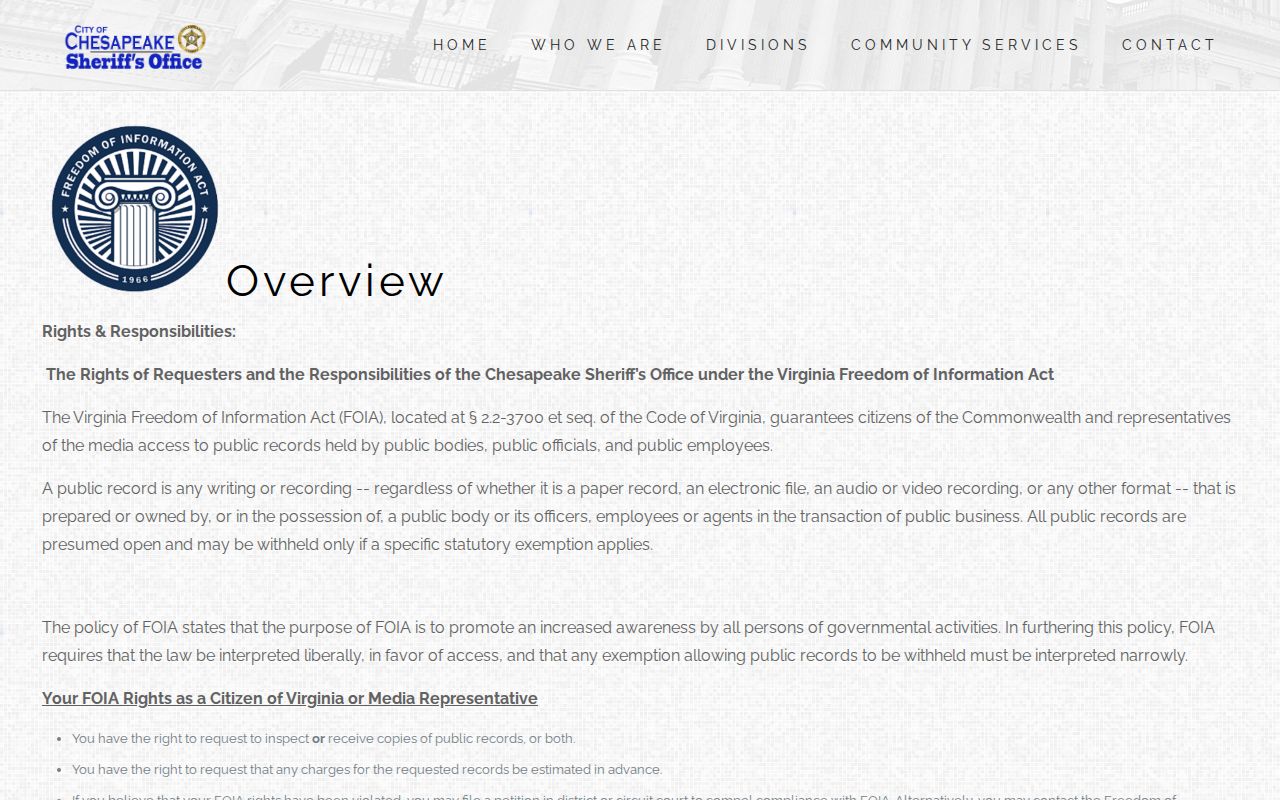
The captured page helps confirm the correct custodian and current submission channels, while the request itself should still identify the exact release or transfer fields sought.
Note: A response deadline is not a promise that every requested field is public or that production will arrive on the first response date.
Chesapeake County Release Record Laws
Virginia Code §2.2-3704 sets the basic access, response, and cost framework. Section 2.2-3706 addresses criminal and law-enforcement records and allows some imprisonment and adult supervision records to be withheld. Public access therefore does not mean that every note in a jail or VADOC file must be released.
The Library of Virginia’s GS-08 schedule, series 100651, directs local agencies to retain cumulative booking and release records for 20 years after separation, followed by confidential destruction. Retention is not the same as web access. It does support a targeted request after the live roster no longer shows a person. Expungement or sealing requires legal authority, generally a court order. Release by itself does not erase the booking or case record.
When Chesapeake County Releases Occur
Chesapeake does not publish a fixed bond-release hour. The Sheriff’s Support Services information says an eligible person bonding out is released once the required paperwork and Magistrate or court authorization are complete. Bond processing can occur 24 hours a day. That means there is no sound basis for predicting a morning or evening batch from public lobby hours.
The Administration and Jail lobbies are listed as open on weekdays and closed on weekends, but correctional operations continue around the clock. Those facts serve different purposes. A family member checking a pending release can call the correctional-center status line at 757-382-2883, but staff processing and judicial authorization still control timing. If the precise time matters later, request the release event rather than relying on when a phone call or portal check happened.
Chesapeake County Release Cycle Scale
The City’s FY2022 adopted budget gives a dated view of Chesapeake Correctional Center operations. It reports FY2020 actual average daily population of 973, an average length of stay of 41 days, and 277 people serving weekend sentences. These figures are historical facts, not current population claims.
Weekend sentences help explain why admissions and exits cannot be reduced to a simple daily list. A booking-date filter describes intake activity, while a release record describes how custody ended. The age of the budget figures also matters. They provide scale and context only, and should never be treated as a present count or used to estimate today’s release volume.
Find Chesapeake County Released Inmates
Start with the agency that likely held the person. The local Tyler portal answers whether an indexed Chesapeake booking is currently marked in custody. It does not serve as a complete archive of all past and present people. A missing record therefore starts a confirmation process rather than ending one.
- Search the Sheriff portal by name, Subject Number, or Booking Number. Keep “In Custody” selected for a present-custody check.
- Save the stable identifier from a clear match. Do not treat Booking From and Booking To dates as release dates.
- If the entry is absent or no longer in custody, call 757-382-2883 and request the Sheriff’s release or transfer record.
- Search Chesapeake General District and Circuit Court records for the disposition and sentencing order.
- When the record shows a state sentence or transfer, search VADOC custody and supervision.
- Follow a federal or immigration detainer through the receiving agency’s official locator.
The official Sheriff inmate lookup landing page includes the local disclaimer and route to the live inquiry.
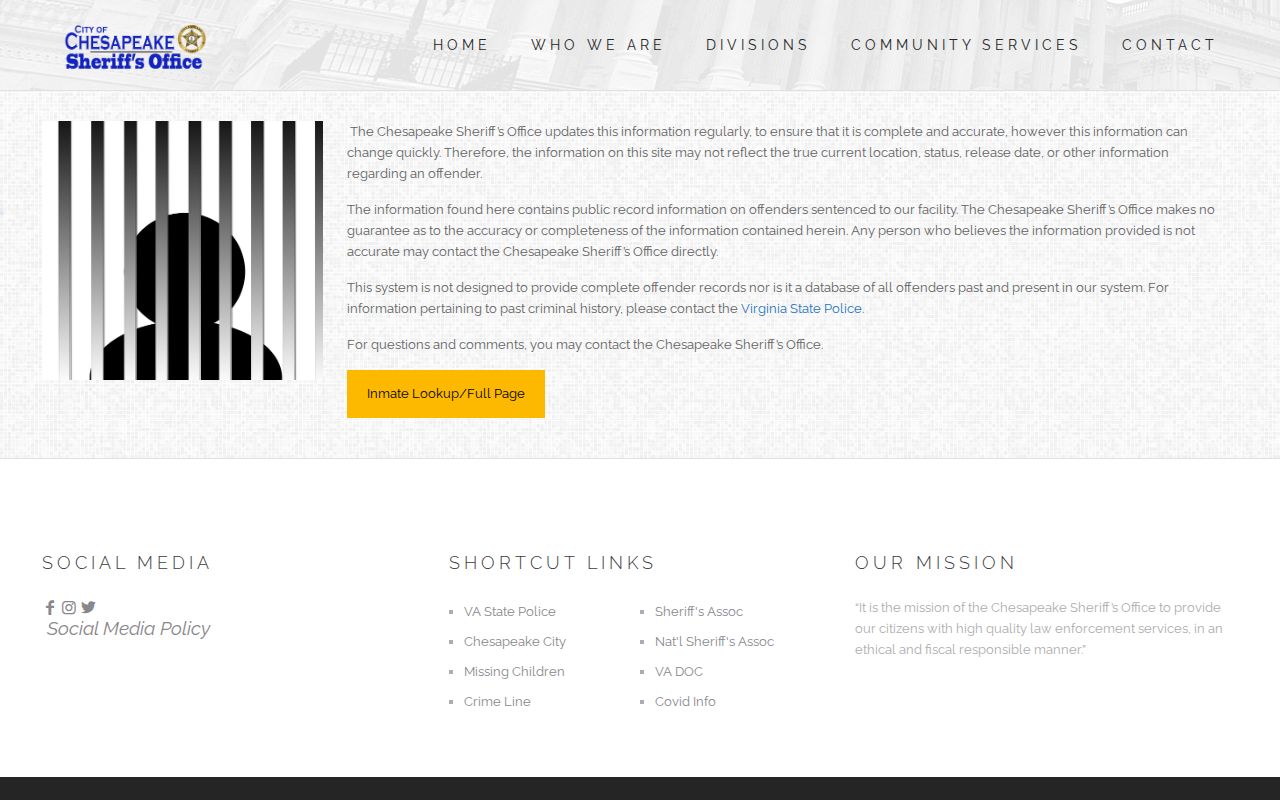
The image shows why the official local search is a first check, while a past release still needs the Sheriff record, court trail, or receiving-agency status.
Search VADOC Chesapeake County Releases
The VADOC Inmate and Supervisee Locator is the correct statewide search for someone under Virginia corrections custody or supervision. It accepts the first three characters of a first name and a full last name of at least two characters, or a seven-digit DOC ID. Advanced filters include location, race, gender, and age range. The user must accept the disclaimer and complete the current CAPTCHA.
| Search field | Use | Limit |
|---|---|---|
| First and last name | Broad person search with minimum character rules | Common names may return several people |
| Seven-digit DOC ID | Direct identifier search | Applies to VADOC records, not local booking numbers |
| Location | Narrows a current custody or supervision result | A changed location can mean transfer, not release |
| Race, gender, age | Helps resolve possible matches | Compare the full official record before selecting |
VADOC says the locator is updated daily but may be inaccurate or outdated. Its public policy permits release-date information, projected parole eligibility, mandatory parole or good-time dates at inquiry, correctional status, custody or parole status, and facility location where applicable. The exact label on a live result must be read as shown. A fully discharged person may fall outside the locator’s described population, so no result cannot prove discharge.
Open the current VADOC locator to compare the actual search controls and result wording.
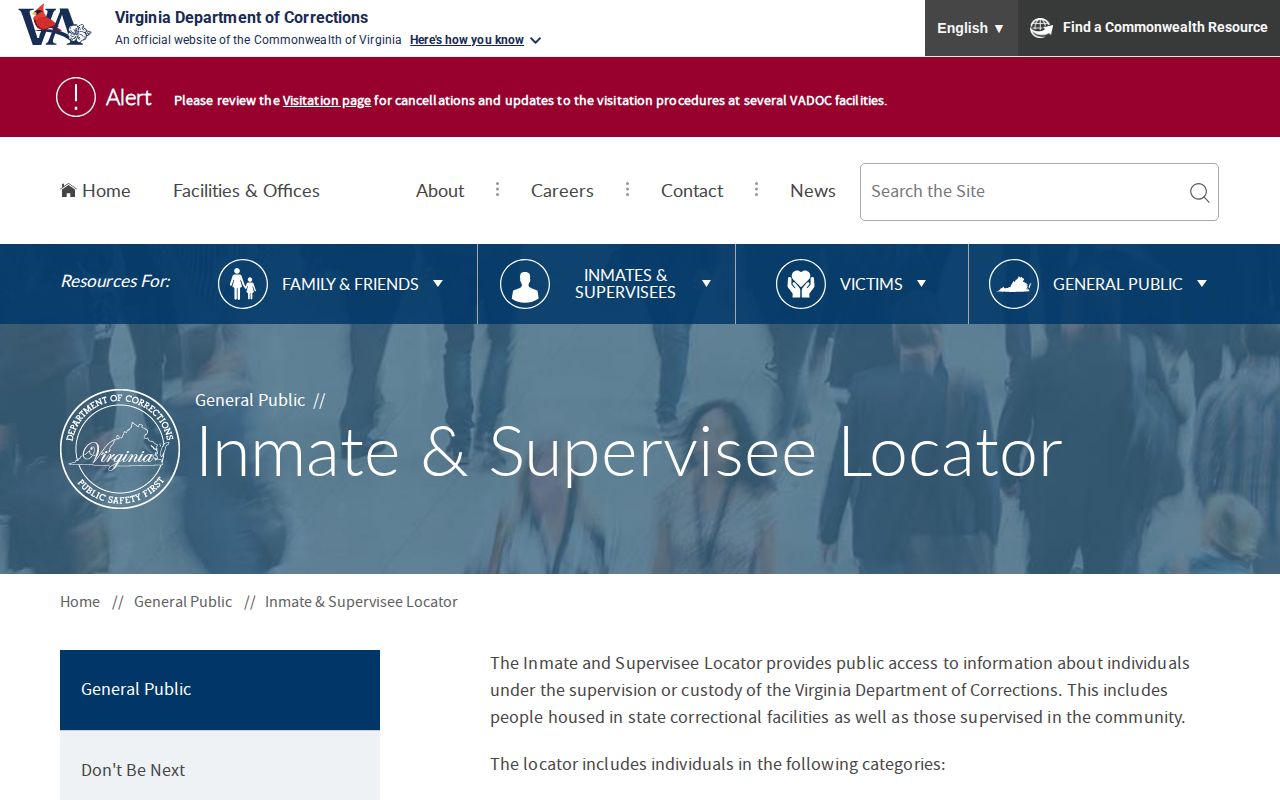
The captured locator identifies the state search boundary. It should be paired with signed release papers or a narrow VADOC record when an exact discharge must be confirmed.
Chesapeake County Release Feed Limits
No official Chesapeake 24-hour, 48-hour, or 72-hour release feed was found as of the research date. The Tyler form has Name, Subject Number, Booking Number, an In Custody checkbox, Booking From Date, Booking To Date, and Housing Facility. Its grid can show a photo, name, subject number, current custody flag, and physical descriptors. Booking dates refer to admission. They are not an exit window.
The Sheriff says portal data is updated regularly and may change quickly, but no numerical update cadence or online post-release retention period is published. There is also no verified official Sheriff mobile jail app or routine release-photo feed. For a same-day view of what can and cannot be confirmed, the Chesapeake 24-Hour Releases page keeps the booking filter separate from the records-request path.
Note: A 20-year agency retention rule for cumulative booking and release records does not turn the live portal into a 20-year public archive.
Chesapeake County Release Supervision Paths
Chesapeake has several distinct post-custody structures. VADOC Probation and Parole District 31 handles state probation and parole from 808 Live Oak Drive, Suite 125, Chesapeake, VA 23320, at 757-424-6760. Probation is supervision ordered by a court and can follow jail or be imposed without incarceration. Parole is supervised release from incarceration for a legally eligible person.
Chesapeake Community Corrections, at 100 Outlaw Street and 757-543-2844, supports local pretrial and community-based probation programs. Court and recovery initiatives form another part of the local transition landscape. The release order tells the reader which authority applies. A VADOC supervisee result should not be assumed for every locally supervised person, and a past Chesapeake address does not establish a current District 31 case.
Verification should begin with the named authority on the order, then the VADOC locator or court docket as appropriate. Adult supervision case files may be withheld, so ask for a narrow status or discharge document instead of a whole file. The differences and confirmation steps are covered in more depth under Post-Release Supervision.
Chesapeake Courts Confirm Release Grounds
The adult case trail may be split between two Chesapeake courts. General District handles misdemeanors, traffic matters, and preliminary stages of felony cases. Circuit Court handles felony trials, appeals from district court, and final sentencing orders in many felony matters. A dismissal or transfer notation at a preliminary stage should not be mistaken for the last outcome.
Use the Virginia case-information gateway, then search both relevant Chesapeake systems by party name or case number. Compare the charge, disposition, disposition date, active jail term, suspended time, probation, and later orders. If the summary is unclear, obtain the order from the clerk. Circuit Court is at 307 Albemarle Drive, Suite 300A, 757-382-3000. General District Court is at 307 Albemarle Drive, 757-382-3100.
A court order proves legal disposition, but it often does not prove the physical exit time, jail credit applied, or a detainer handoff. Pair it with the Sheriff release or transfer record. That evidence hierarchy preserves an apparent conflict instead of forcing two valid but different agency events into one answer.
Chesapeake State-Prison Release Geography
Indian Creek Correctional Center and St. Brides Correctional Center sit on neighboring Sanderson Road addresses in Chesapeake. Their location can cause a local search error. Both are VADOC state prisons, not branches of Chesapeake Correctional Center. A person leaving either prison belongs in the VADOC locator, release-paper, records, and state-notification path.
A prison departure may mean transfer to another VADOC institution, discharge to the community, parole or probation, or a detainer handoff. A changed facility line alone does not settle which occurred. VADOC states that a person who has satisfied the state sentence is discharged or leaves on parole, receives a notification-of-release letter, and has applicable release or supervision documents read, signed, dated, and witnessed. Those papers and the later status are stronger evidence than a search snippet.
Note: Physical proximity does not make Indian Creek and St. Brides interchangeable, and neither state prison should be checked through the Chesapeake city-jail roster.
Chesapeake County Release Notification Paths
Virginia uses separate notification systems. Virginia Jail VINE can provide a specific-person custody search and event registration for participating local-jail data. If a matching result says released or out of custody, it reflects an event transmitted by the participating agency. It still may not provide the exact local disposition. For a VADOC prisoner, the separate NAAVI system handles eligible state notifications. A VINE registration does not automatically follow a person into VADOC.
Federal and immigration records form two more paths. The BOP Inmate Locator can show a federal release date or “Not in BOP Custody,” but that does not rule out another custody system or supervised release. When a Chesapeake record lists an immigration transfer, the ICE Online Detainee Locator is the next public check. Read its result with the Sheriff receiving-agency entry because release from Chesapeake custody may be admission to ICE custody.
Compare Chesapeake County Release Status
Each official system has a defined role. Start with the one that owns the custody event, then move to the next agency only when the record points there. Repeating the same name across unrelated databases is less reliable than following a booking number, case number, DOC ID, detainer, or receiving-agency field.
| Source | Still in custody | After release or transfer |
|---|---|---|
| Chesapeake Sheriff portal | Current indexed local status with “In Custody” field | May change or disappear; request the release record |
| Sheriff Records | Booking, charges, bond, sentence, and detainer file | Release time, disposition, authority, and transfer evidence |
| Virginia courts | Pending case and court orders | Durable disposition, sentence, probation, and later orders |
| VADOC locator | State custody and location | Supervision or date/status data where displayed |
| BOP locator | Federal location or status | Past federal release date or no BOP custody |
What if two sources seem to conflict? Check their timestamps and agency boundaries. A local release and a VADOC admission can both be correct when the event is a transfer, just as a future date and a parole grant can coexist before physical release.
Chesapeake County Release Facilities
Four facilities shape Chesapeake release searches. The city jail, two state prisons, and confidential juvenile center each require a different confirmation method. Facility name and operator should be resolved before any record is treated as proof.
- Chesapeake Correctional Center holds local, state, and federal admissions; use Sheriff status and release or transfer records.
- Indian Creek Correctional Center is a VADOC prison; use VADOC discharge, supervision, and transfer sources.
- St. Brides Correctional Center is a separate VADOC prison with the same state-record boundary.
- Chesapeake Juvenile Services Center uses confidential court, family, and DJJ processes, not an adult inmate search.
Hampton Roads Regional Jail may appear in older Chesapeake records, but dated budget material does not prove a current placement arrangement. Likewise, a historical federal detention agreement is not evidence of a current contract. When a transfer field names another facility, verify that receiving agency directly.