
Chesapeake 72-Hour Release Reality
No distinct official Chesapeake 72-hour release list was found as of August 8, 2026. The Sheriff’s Tyler/New World portal accepts Booking From Date and Booking To Date, but those controls describe entry into custody. Expanding them across three days produces a list of bookings in that span. It does not show who departed, when custody ended, or whether the outcome was release to the community or transfer.
The broader three-day horizon remains useful when treated as a research window instead of a feed. It allows time to compare the portal’s “In Custody” status with Chesapeake General District or Circuit Court activity, a Virginia Jail VINE event, and any VADOC result after a state transfer. Each channel proves something different. The Sheriff release or custody-transfer record remains the best local document for exact exit time and destination.
Check Chesapeake 72-Hour Releases
A three-day review should build a timeline. Start with the local booking identifier, then compare the systems that can show later action. For an event that may have happened today, the Chesapeake 24-Hour Releases path emphasizes direct same-day status checks.
- Search the official Sheriff/Tyler inquiry by name, Subject Number, or Booking Number and note the current “In Custody” value.
- Record the booking identifier and the exact time of the search. Do not use Booking From/To as a release range.
- Search Chesapeake General District and Circuit Court records for a disposition, sentence, dismissal, or later order during the three-day period.
- Check Virginia Jail VINE for a transmitted local custody event when a matching person can be identified safely.
- Call 757-382-2883 if the local status is time-sensitive or unclear.
- Request the Sheriff’s release or custody-transfer record for the exact date, outcome, authority, detainer, and receiving agency.
- Follow any state, federal, or immigration transfer in the system named by the record.
Do not choose among people by photo alone. Names can repeat, and an old photo can persist away from its source context. Subject Number, Booking Number, court case number, date of birth when lawfully available, and facility information provide a safer match.
Chesapeake 72-Hour Release Fields
There is no online three-day release table to interpret. The honest field inventory separates what the current portal shows from what must be obtained through a records request. This prevents an admission date from being reported as an exit date.
| Field or event | Safe reading | Best next check |
|---|---|---|
| In Custody: Yes | The portal presently indexes local custody. | Call if the status is urgent. |
| Record disappears | Outcome is unknown. | Ask for release or transfer disposition. |
| Booking date in range | Admission occurred in the span. | Do not infer release. |
| Court disposition | Shows the legal case outcome. | Use Sheriff Records for physical exit. |
| VINE event | Shows a transmitted custody change. | Read the exact wording and confirm disputes. |
| VADOC result | May show state custody or supervision. | Distinguish transfer from community release. |
The Chesapeake Tyler portal displays the real booking fields and current-status checkbox.
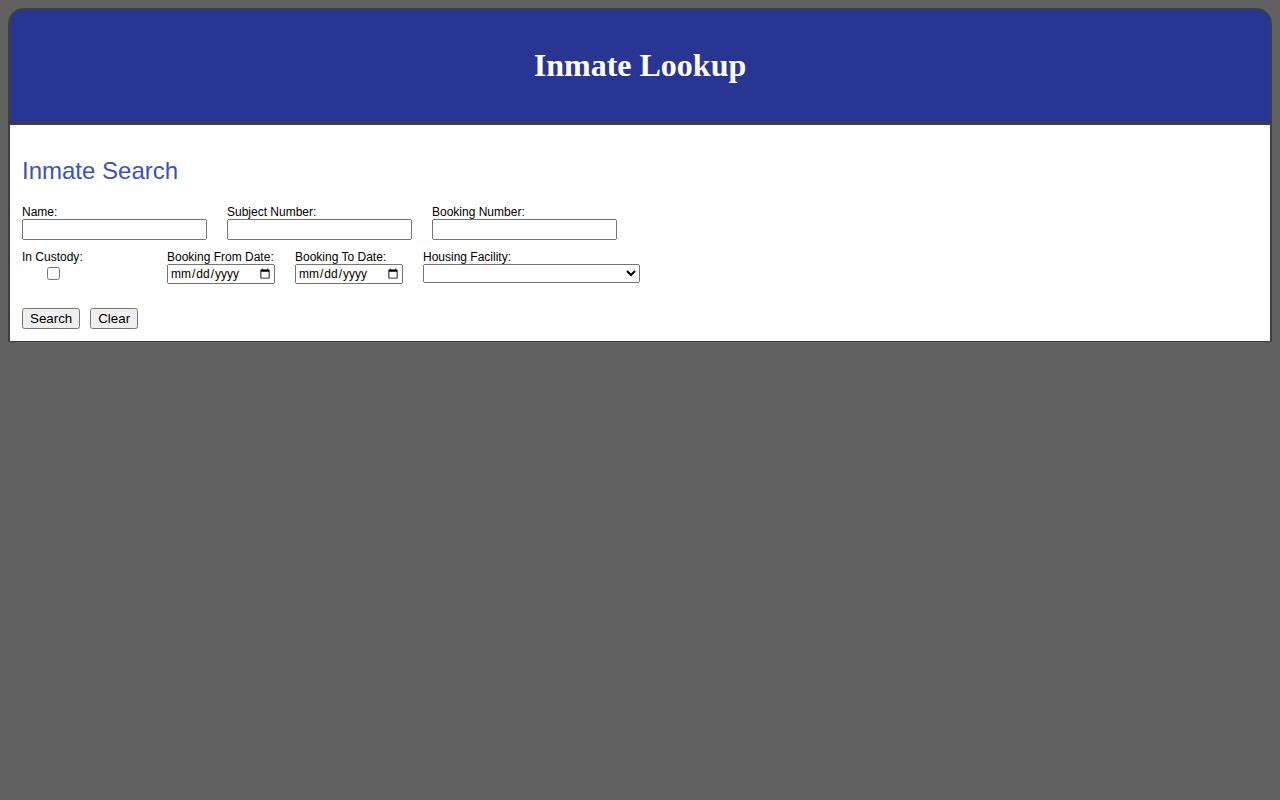
The screen supports identity and custody checks, but its date controls remain tied to booking rather than release.
Chesapeake Weekend Release Checks
Chesapeake Correctional Center operates around the clock, while public Administration and Jail lobbies are listed for weekdays and closed on weekends. Those facts address different functions. Custodial release processing can continue when a public counter is closed. A person bonding out may be released once all paperwork and Magistrate or court authorization are complete, with no fixed daily batch time.
A three-day review can span days when a records desk or court clerk is not open to the public. Use the current portal and status line for the immediate check, then obtain the formal record during available office channels. Court entries are valuable because they may show a dismissal, sentence, or order that remains visible after a roster change. Yet a court disposition usually does not show when intake staff finished release processing or whether another authority took custody.
The Sheriff’s Support Services information explains bond timing and the role of Records.

It shows why a weekend release is controlled by completed authority and processing, not by an online three-day list.
Note: Public lobby hours do not set Chesapeake release hours, and a holiday does not create a documented online catch-up feed.
Chesapeake Booking Dates Mislead
The portal’s date labels create a local data quirk that deserves its own check. A person booked before the selected three-day span can be released within it and never appear in a booking-date query for those days. At the same time, a person booked within the span can remain in custody after the window closes. The query therefore has both false omissions and false inclusions if it is treated as a release list.
Online disappearance also has no stated retention timetable. The Sheriff says data changes quickly and is not a complete account of all people held past and present. By contrast, Library of Virginia GS-08 series 100651 instructs local agencies to retain cumulative booking and release records for 20 years after separation. Retention supports a request to the custodian. It does not require the public portal to display a former booking for that period.
Save identifiers when a clear match is visible. They can help Records find the existing file after the portal no longer returns it. Never preserve or republish extra personal detail that is not needed to confirm the event.
Chesapeake Court Release Trail
The three-day window is more likely than the same-day view to benefit from court research. Chesapeake General District Court handles misdemeanors and preliminary felony stages. Circuit Court handles felony trials, appeals, and many final sentencing orders. A disposition found in General District may be only one stage, so correlate the case number and dates across both systems before treating it as final.
A dismissal, sentence, active jail term, suspended time, probation order, or later docket entry can explain why custody changed. Still, the docket usually cannot establish the exact physical exit time, jail-credit calculation, or detainer handoff. Use the court record for legal disposition and the Sheriff record for the custody transition. The Chesapeake released-inmate lookup sets out the named-person path when the three-day scope is less important than confirming one individual.
- Disposition
- The legal outcome entered in the court case.
- Suspended time
- A sentence portion not served at once, subject to the court’s terms.
- Custody transfer
- A handoff to another agency rather than release to the community.
Verify Chesapeake Three-Day Releases
When no online feed exists, request the document that directly answers the question. The Chesapeake Sheriff FOIA page covers records of people held in the correctional center, past and present. A request can be made by mail, fax, email, in person, or telephone. Written wording is recommended because it lets the requester specify the exact event and avoid a broad file request.
Provide a full name plus a Subject Number, Booking Number, or narrow date. Ask for booking and release or custody-transfer records, including the release date and time, disposition, authorizing document, detainer entry, destination, and receiving agency. Virginia FOIA provides five working days for a response. Written notice may add seven working days when timely production is impracticable. Actual costs may be charged, an estimate is available, and a deposit may be required when the estimate exceeds $200.
Virginia Jail VINE is a supplemental local notification channel, not a list of everyone released. VADOC uses a different system for state custody. If a person appears in the VADOC locator after leaving the local roster, the evidence points to state custody or supervision until the precise status says otherwise. A BOP result handles federal custody. ICE’s locator follows an immigration handoff. The receiving agency field in the Sheriff record determines which path belongs next.
Read the systems in time order. A court order can authorize release before the jail finishes processing. A Sheriff record can then show that local custody ended, while a receiving-agency entry shows that physical custody continued elsewhere. VADOC says its locator is updated daily but may still be inaccurate or outdated. VINE depends on the participating jail’s transmitted event. These limits are why a later database result should be used to explain the transition, not to overwrite the earlier event. If records conflict, preserve both timestamps and ask the agency that created each record to clarify its own entry.
Juvenile custody is outside this adult process. Chesapeake Juvenile Services Center has no adult-style public inmate lookup, and release information follows confidential court, parent or guardian, and DJJ channels. An adult portal search should never be used as a substitute for that protected process.
Note: A strong three-day timeline keeps booking, court action, jail exit, and any receiving-agency entry as separate events.